
Proof the Roman Government invented Jesus’ story - in 12 minutes
A rapid walk-through of how an effort to catalog the parallels between the Gospels and ‘War of the Jews’ stumbled across evidence that proves Jesus’ story and his “render taxes to Caesar” message originates from the Roman Government in the AD 70s.
To see the evidence itself go to https://www.academia.edu/105659113 or download the pdf > at https://www.nakedgodsplay.com/

@unabomber It's more complex than that, most of the new testament was written decades or centuries after Jesus death. Churches from different regions had their own spin of Jesus history according to their own values and local laws. Later, Constantinus declared heretics everyone who didn't follow the Roman approved versions and destroyed their texts. The romans didn't invent the story of Jesus, they just took out everyone that didn't agree with their take on the history of Jesus
@doggel in the video it says Constantine had to do that so than Romans did not start worshipping prior emperor’s Titus and Vespasian as gods. This was undesirable to later roman emperor due to political reasons.
As for the gospel of Luke still having the signature of roman intervention doesn’t require the gospel of Luke to be written early or late. As long it used the verses from older sources like Q it would still end being similar to Josephus’s War of the Jews
Christianity was created by Romans as part of a disinformation campaign to pacify Judean “antifa” rebellions by rewriting the teachings and life stories of its founder(s) James (and his supposed brother Jesus) so as to make it pro-Roman.
Religion before mass media worked partly like CNN/FOX/MSNBC (M5M). It told us who are on the right side of history, and who we should hate/cancel.
Romans lacked national media to spread their good news. So they started installing a statue of Caesar in every temple they conquered. This was OK with the polytheists, but the only monotheists i.e. the Jews did not like another god to worship, so they revolted.
The Greeks also tried this before Romans but certain wealthy and powerful Jews (not Soros) i.e. Maccabees revolted and expelled the Greeks. But Jews liked the Greek/Western culture so they sent their kids to Greek schools etc.
When Romans tried to install Caesar as God in the Second Temple, the Jews couldn’t accept it but by then there was no Maccabees to expel the Romans. So Jews resorted to believing in various prophecies they had like the prophecy about a Messiah and the heavenly angel army (a.k.a heavenly host) that would wage war for Jews against Rome. A Jewish sect called “The Poor” (Ebionites) and their allies like Sicariis, Essenes prayed and fasted in the desert so as to invite the heavenly host among them and go to war with Rome. They did go to war against Rome and lost, which ended with the destruction of the Second Temple of the Jews in 70 A.D. This was the modern equivalent of nuking the cube in Mecca. Jews never forgot.
Only one type of Judaism was allowed to operate in Rome after that and it is called the Rabbinic Judaism because it was most aligned with Rome.
Christianity became a compromise between polytheism of Rome, and the monotheism of Judaism, and the polytheists around the world loved it.
In the New Testament, we read exhortations to obey the Roman government as the appointed agents of God, to pay one’s taxes, and even to honor the emperor himself. We also see the earliest Christian leaders laying the foundations for the authority structure of the Church, with an endorsement of Church hierarchy coming even from Jesus long before such developments seem credible. We are presented with benevolent Roman centurions, even as Paul’s mission uniformly receives official protection from Roman governors, clerks and officials—including sympathy from the Praetorian Guard of Caesar himself.
According to Christ, the faith of one centurion exceeded that of any contemporary Jew. Paul refers to his contacts as those in “Caesar’s household” so casually in his correspondence to the Philippians it must have some basis in fact. Indeed, Paul’s contacts reach the highest level of imperial servants and Roman aristocrats, including associates of Vespasian and Titus who had achieved their imperial office by conquering the messianic Jews and becoming Jewish messiahs and Roman man-gods.
This same family of Roman emperors produced a 1st Century “pope.” Most of the New Testament was composed during their reign. Their family tomb became the first Christian catacomb. Their family symbol was Christianity’s first icon: the anchor.
The founder of the Flavian dynasty, Vespasian, presented himself as “the New Serapis” and performed healing miracles identical to Christ’s, syncretizing pagan elements of a mystery religion with his own status as the Jewish Messiah. Vespasian advertised himself as the father of universal peace, a new Pax Romana. And he was a monarch born to humble circumstances. Both his ascension to the throne and his death were portended by a star.
Jesus, too, was a Jewish messiah, a divine “monarch” born into humble circumstances, and his birth was heralded by a star.
Both Vespasian and his son, Titus, were worshiped as savior gods in the East while they lived, and they were worshiped as official state gods in the city of Rome itself long after their deaths. The Gospels, no matter who wrote them, would have been ideal prophetic demonstrations of their divinity and messianic status as Roman Jewish Messiahs.
The cult of Emperor Titus praised his beneficence with propaganda extolling his charity and fatherly love for the masses. Within only a few decades of his death, after his brother Domitian was assassinated, his dolphin-and-anchor motif became the predominant symbol of Christianity.
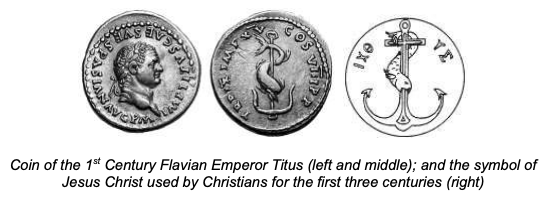
@doggel The Gospels systematically, even melodramatically, absolve the Roman Empire of any culpability for the death of Jesus, laying the blame exclusively on the Jewish people with such a heavy hand that it inspired centuries of anti-Semitic retribution.
The Flavians’ own historian, Josephus, favorably portrays New Testament protagonists who are associated with the Flavians. The New Testament expresses inordinate sympathy for Titus’s own Jewish friends. Though he became an object of shame to his own people, Christians to this day enthusiastically cite Josephus as frequently as any Church father.
As Jesus explains in the Gospels, he is himself the replacement of the Temple that Titus would destroy: he was the ultimate sacrifice, the complete Atonement for the sins of the People, and the final reconciliation of man with God.
If Christianity was an organic development from Judaism, the product of an evolutionary process, one would expect that the most culturally alienating aspects of the mother religion, such as male circumcision, strict Sabbath observance and Kosher diet, would have disappeared slowly, one-by-one, over a period of time. We have seen how fiercely the first Christians fought for these traditions against Paul. It was those very aspects of Judaism for which the rebels were fighting, the features of their culture that created problems of intermarriage, inter-employment, and even made having lunch with Gentiles a source of heated conflict. In the work of Paul and the authors of the Gospels, however, we see all of these aspects of Judaism swept aside suddenly, stridently, simultaneously. And we see it all happening among a group of messianic Jews, the group least amenable to any modifications of the Torah. More than that: they were done away with at the same time pagan elements and ideas were introduced, transforming the faith into a kind of Mystery Cult that worshipped a man-god.
The first Gospels were written during the Flavian era by authors familiar with Jewish religion and history, just like the people who happened to surround the “Messiah” Titus. This same group included Titus’s second-in-command, Tiberius Alexander, the nephew of the Jewish Platonist philosopher, Philo; also, the historian Flavius Josephus, who produced a history of the Hebrews from the Creation to their war with the Romans and who received the holy Jewish texts from the Temple after it was sacked; also the long-serving Imperial Secretary of Letters, Epaphroditus, who assisted Paul and Josephus; also Pliny the Elder, who endorsed the divinity of helping others, praised as divine this quality in the Flavians, and dedicated his own works to Titus; and even the Jewish royals Agrippa II and Bernice (Titus’s one-time fiancée), who appear in the Bible itself.
Some of these figures in the New Testament stood shoulder-to-shoulder with Titus during the Siege of Jerusalem and witnessed the central prophecy of Jesus being fulfilled: the same events recorded by Josephus in terms that match the Gospels’ prophecies down to the last visual detail. And both Jesus’s prophecies and Josephus’s histories were written concurrently after the events had taken place and during the rule of the Flavians.
The unique combination of means, motive and opportunity, of time, place and people, surrounding the Flavians perfectly coincides with the origins of the New Testament. The oddly organized and widespread administration of early Christianity so unaccountable to scholars implies a top-down governmental hand in its creation. Moreover, such a widespread effort could have been mounted so publicly in the wake of the Jewish War without Roman sanction is impossible to believe.
The idea that Christians would be so favourable to the Romans, by praising a centurion’s faith so extravagantly in the New Testament or adopting an emperor’s seal as their own at their gravesites, simply in order to avoid persecution contradicts the entire story of Christian martyrdom and their refusal to appease pagans. Occam’s razor hovers overall efforts to explain away these facts, which collectively and effortlessly conform with this theory.
At the crossroads of Western history, the great Jewish War with the Romans was a conflict of two diametrically opposed views of civilization: one that was exclusive vs. one that was universal. Their epic collision created an urgent need for the exclusive side to protect its heritage against invasion from outside pollution (as evidenced even in the last ditch depositing of the Dead Sea Scrolls) and the Romans’ need to defeat the militant exclusivity that opposed their comparatively pluralistic empire.
@unabomber There is some problems with that theory, I point it out in no particular order:
The bible also absolved jews from Jesus death, saying that him being tortured and sacrificed is the will of the father, in order to be sacrificed for the forgiveness of everyone sins, and both the jews and romans actions are necessary for such end (1/?)
@unabomber Paul was preaching way before the jewish-roman war, documents and letters go back all the way to 48 AD already mentioning christian communities. And Paul do praise jewish traditions, but says things like circumcision and what not is worthless if not following God's word, instead he makes the case that salvation is not just for jews but for gentiles too, and if jewish customs get in the way of salvation, then there's no need for gentiles to follow such customs (2/?)
@unabomber The odd level of organization of the christian communities is because Jesus himself appointed the disciples as leaders. And almost all non-naturist religions have such an organization from the very beginning, even modern sects tend to revolve around one leader in a centralized form of organization
Also, if the history of Jesus was a roman fabrication done by people who know of jew culture, (3/?)
@unabomber Bethelem a clear fabrication trying to retrofit on the idea of Jesus of Nazareth, also, if the romans were the one who fabricated this, shouldn't they at least knew their own history from some decades ago?
Also, the jews believed the messiah would come from their tribe (tribe of Judah), instead Jesus closest blood related tribe is the tribe of Levi (the tribe where the high priests come from). A fabrication aimed at jews shouldn't have this problem, either. (5/?)
@unabomber The gospels are indeed retrofited versions of Jesus history to appeal to either romans or jews and convert them to christianity. But Jesus history wasn't a fabrication in itself, otherwise, the retrofited parts wouldn't have such plotholes. (6/6)