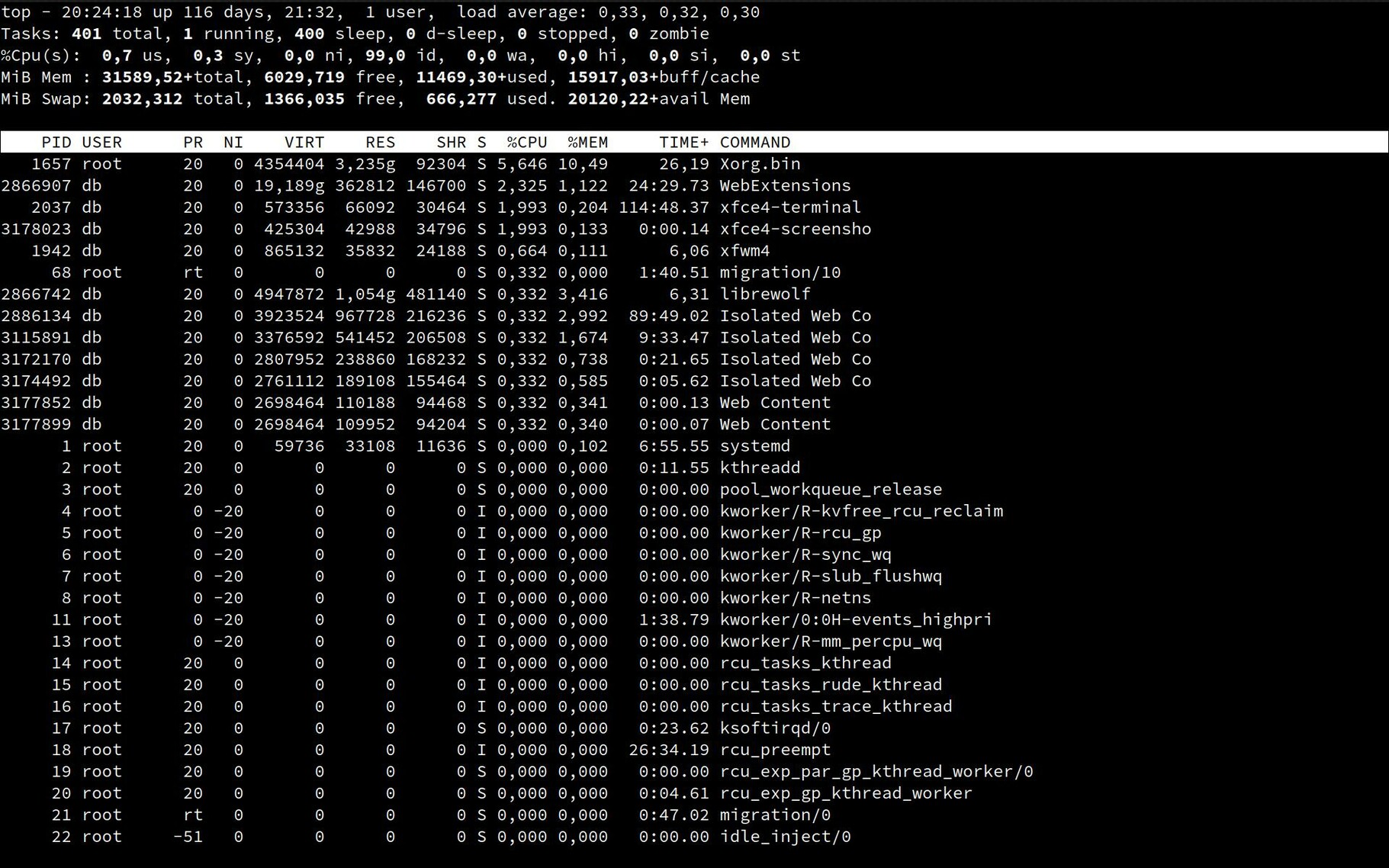
@[email protected]Yeah, but that's the point, now try that with a single core and "stuff always happening in the background" would be very noticeable — it's particularly striking on a machine with 2-4 cores, in systemd-less Void the machine is actually idle and it remains ice cold, with systemd distro some stuff always keeps popping up in the background, in top it would still look like >90% idle, but the workload just gets spread thin across all cores and neither or them sleeps, CPU clock remains high and heat doesn't dissipate fast enough — the machine feels warm, unless the fans kick in.
The example with machine in my top post is illustrative because there is only one core, it's a 1,5 GHz Pentium-M machine, but when the system is idle, CPU clock falls to 800 MHz (I can see hw.cpuspeed=800 with sysctl), not because it's locked at that frequency, but because CPU actually has nothing to do. And of course I can see e.g. Profanity pop up in top, but I know that some event must have happened, it keeps receiving messages — I can tell what it's for. In systemd-based distro some things keep popping up, but I have no idea what some units/services are for — they are just there to keep the system going, but this workload isn't meaningful to me as user.
And it's true, it might seem that all of this is no big deal on a modern multi-core machine, but with wide enough time window the fact that when the machine is idle nothing is happening in the background is still noticeable. I have this Lenovo Yoga 2-in-1 — not sure what year it's from, I think something like 2019-2020. By no means it's a top performer, not it's particularly power-efficient — not one of those fancy ARM machines, just an inexpensive Intel one. And it's battery isn't new, I think it's at 60% of its originally capacity now. Yet with Void Linux (no systemd and less bloat in general) on a single charge with average usage: web browsing, music in the background, occasional video (hours of video playback aren't even that impressive with VA-API and hardware decoding) — I can easily get five hours of battery life, pretty impressive!
Browser parallelism is also a double-edged sword — on the one hand, even inexpensive modern machines have plenty of cores, so why not use them? It sure feels more responsive this way. On the other, like I said earlier, tiny workloads get spread across cores and CPU clock goes up, neither of them sleeps — over the hours it accumulates and results in battery getting drained pretty fast.
Performance of modern machines is sure nice: I can have a dozen of virtual machines, I can build Firefox in under five minutes or something like that 😂 But what's striking to me personally is that on average I can't do much more on a modern machine than I could back in the day when this old ThinkPad was "current" — due to infinitely growing software complexity all this impressive computing power mostly gets wasted on things that do not produce meaningful user-facing results — yep, all those background services that do… who knows what?
But relatively simple system like OpenBSD is still viable even on this laptop from two decades ago, I like this!