
Joined Apr 2026
h4890
boosted

905
THE RULE OF LAW, GERMAN-STYLE: FREEDOM FOR THE EX-CONSTITUTIONAL COURT JUDGE!
You’ve just got to love our model state! A former constitutional court judge and SPD official allegedly hoards a cool 1.7 million files depicting abuse across 40 hard drives, yet the judicial system remains totally unbothered (https://x.com/aldoushuxiey/status/2083646788947321224?s=46). Grounds for detention? None to be found! Naturally, the gentleman remains at liberty. Who needs pre-trial detention for a data haul like that when you’ve got the right old party memberships and connections?
While the average citizen feels the full force of the law for an illegally parked car or unpaid broadcasting fees, a "premium" motto seems to apply here: judges protect judges. It is a slap in the face for every victim—but hey, at least the façade of moral superiority remains intact. The rule of law is working—at least for the elite!
https://t.me/RAWilfriedSchmitz/4509 https://www.minds.com/newsfeed/1931640059350491136
h4890
boosted

New York Will Require Digital ID Checks for Social Feeds
https://reclaimthenet.org/new-york-will-require-digital-id-checks-for-social-feeds
https://reclaimthenet.org/new-york-will-require-digital-id-checks-for-social-feeds
h4890
boosted

"I don't know what everyone else is seeing. I'm hearing they are very good for certain functions. Are you going to have them write all your production code? No. Are they great for prototyping? Yes. Can they help an experienced coder do more with less? Yes. It's a mixed bag. Are they going to replace all medical professionals with medical advice? No."

h4890
boosted

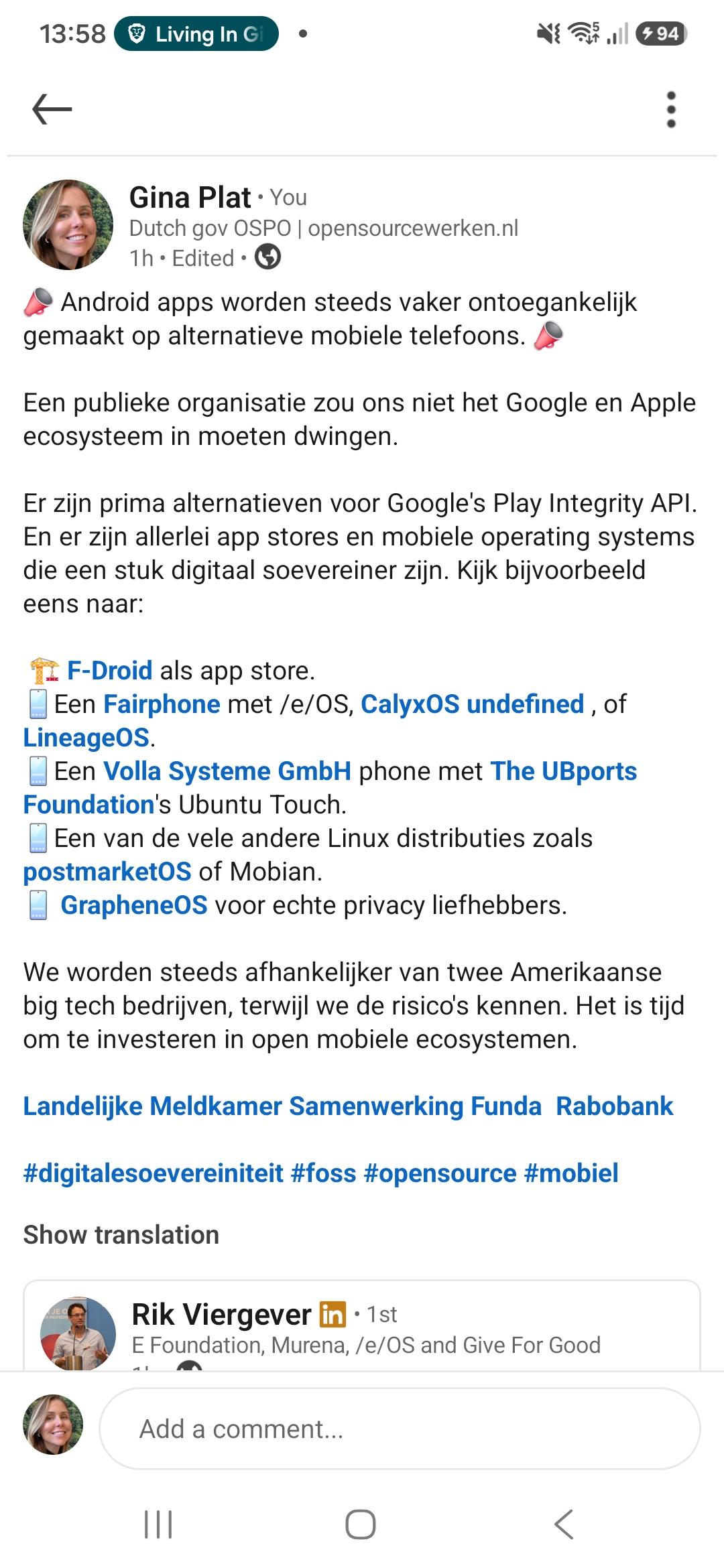
📣 More Dutch companies are making their Android apps inaccessible on alternative mobile devices, by using the strictest Google Play Integrity API settings. 📣
After Funda and Rabobank, now a public collective for emergency controlrooms has made their app inactive on open source OS's. Caught by @rikviergever from @murena .
We can't keep being dependent on two US big tech companies. If we want more digital sovereignty, we'll need to invest in mobile alternatives.
h4890
boosted

h4890
boosted

h4890
boosted

Shit like this is why we can't afford to stop the migrant boats 🤬
h4890
boosted
h4890
boosted

h4890
boosted
Ukraine
I Crane
You crane
His Crane
Her Crane
It's Crane
My Crane
Your Crane
Their Crane
He Crane
She Crane
Them Crane
h4890
boosted

Like, seriously, WTF. It's supposed to be burning Battlefield over there - that's why we accept all the "refugees" and keep sending them fuckin' money!
h4890
boosted
h4890
boosted
Oh and look at that. Apparently that free speech absolutism Musk was preaching was somewhat overrated - the post got me locked out. Let's see what the appeal process does 🤔
h4890
boosted

h4890
boosted


Publishers Are Losing Google Traffic As AI Answers Replace Links https://news.slashdot.org/story/26/07/31/1639202/publishers-are-losing-google-traffic-as-ai-answers-replace-links?utm_source=rss1.0mainlinkanon
h4890
boosted

Would you like to see ICE deport NYC mayor Zohran Mamdani, a Muslim who was born in Uganda?
h4890
boosted
So this is apparently needed.
Dear Mastodon,
While we all say "AI" regardless of whether we're talking about text, audio, images or video these are not all using the same underlying technology*.
Large Language Models, LLMs, use a technology known as Transformers. They "got smart" beginning in 2017 when a paper named "Attention is all you need" was published by Google. One way of describing LLMs is that by caring for everything that comes before, you can perform the next step.
Audio, Images and Video mostly use a technology called Diffusion which began in 2015 but became noticable better in quality with CLIP from 2021. That technology can be said to work by starting with noise and then seeing whether any changes you make cause an evaluation to be more or less what you want in the end.
LLMs do not want to store training data in the models because that means they're less smart. Knowing the answer to a question is useless - knowing how to get to the answer is valuable. Diffusion models however don't have a problem with this. Knowing what a rose looks like is knowing what a rose looks like. Knowing what a Dali painting looks like ... yeah you get it.
What has been a bit shocking to everyone is that LLMs turned out to be generally useful and not just language engines. While the intention was for them to understand text, produce text and reliably translate between languages, it seems that by using text to encode knowledge about the world we also got engines that could "think" and "reason" about the world - and that has over the last year or so caused an explosion in LLM usage in, for example, software development.
This was not something first dreamed up by commercial entities wanting to sell products - but by curious programmers wanting the Next Great Tool. If there's one thing us programmers are it's _lazy_. If we can automate a task we will.
*) Yes I'm taking a shortcut. There are overlapping areas, but the point still holds.
h4890
boosted
Love the feedback I'm getting on the ST:TNG voice interface clone :) As an FYI, I've taken up the old IRC-practice of idling in a channel for anyone who'd want to discuss that or other local LLM projects.
Although nowadays I do prefer #Matrix to IRC: https://matrix.to/#/#LocalLLaMa:argot.se





Joined Apr 2026