houseoftolstoy @[email protected]
Looks like this will be my new home. Warning: I (probably) have Asperger's, so my be prepared for my autism to show through.
I don't think I am a right wing extremist, but I am sure anyone with low testosterone might think otherwise.
Joined Sep 2022
houseoftolstoy
boosted
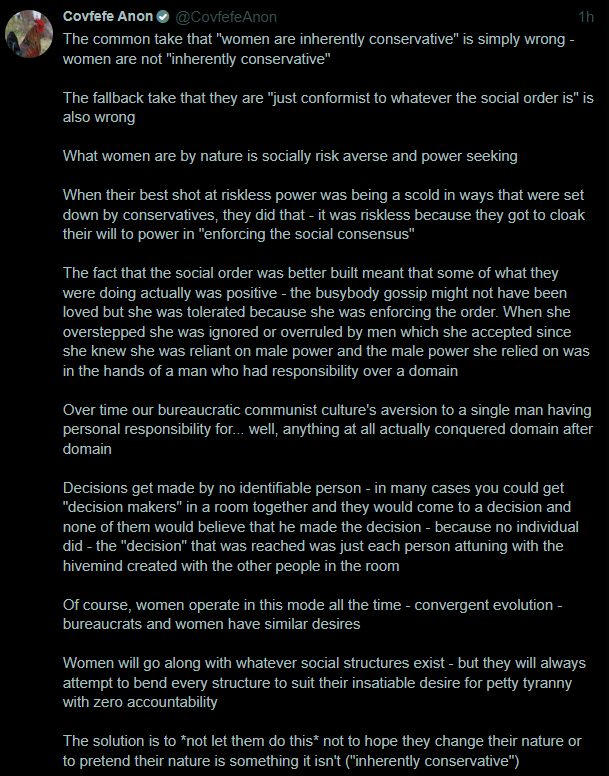
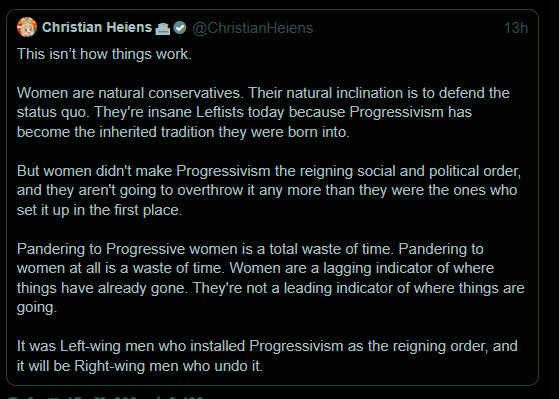
what's interesting here is that I think both are right in the sense that "socially risk averse" is a pretty spot on definition of modern conservatives.
Also, Covfefe's behavioral definition of women is worth saving.
Also, Covfefe's behavioral definition of women is worth saving.
It is like asking Lebron James how you can be a great basketball player like him, and he responds with "Eat your vegetables, get lots of exercise, get a good nights sleep every night and practice your basketball skills!"
Sure, this might help you to do better in your general health and possibly basketball, but lets not ignore the fact that genetics is a huge factor in his success, and a large part of why many people cannot simply copy what he does and be an NBA star.
A large part of the issue of Boomer-tier advice of "eat out less often and spend less on frivolous things" is not that it is bad advice. Spending less money on eating out and finding ways to save money can go a long way for your bottom line.
The problem is that Millennials and Zoomers can follow this advice to a T and still find themselves unable to afford a home where they live. The expensive home prices is the real issue, and it is a slap in the face to younger generations to ignore this fact
houseoftolstoy
boosted
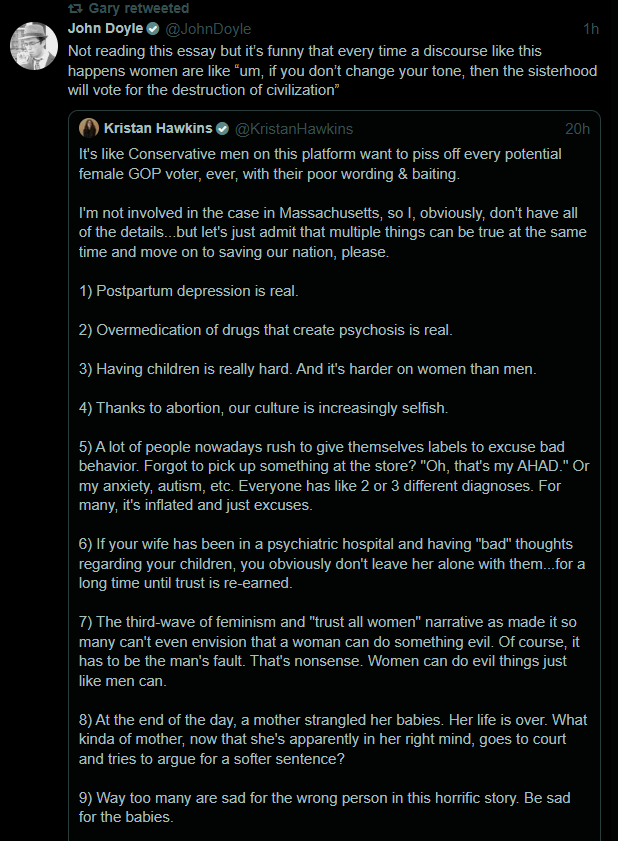
what's interesting is she starts off saying that and basically then restates what most people are upset about.
Classic foid "you didn't have to say it like that!"
Classic foid "you didn't have to say it like that!"
But it turns out, we could still do those "essential" things, so long as we followed a bunch of rules that really would not help considering how even people following the rules to the best of their ability would still not be realistically able to prevent spreading viruses in general.
Along with that, the multiple goalpost shifts for the lockdown timeframe made it clear the government was full of shit there too. The BLM riots being allowed just made it even more obvious.
Looking back on the Covid panic, there were earlier signs that our government was full of shit than the BLM riots after George Floyd. While not as overt as permitting the riots, the looser definition of "essential jobs" being put in place should have raised eyebrows far more.
Early on people were worried that they would need to scrape the bottom of their fridges and pantries, since people were thinking that they would not even be able to get to grocery stores with how dangerous it was.
houseoftolstoy
boosted
houseoftolstoy
boosted
the average immigrant is a massive net drain, even without starting to include the real hidden costs.
When it comes to the discussion of Flock cameras, there is one important topic to consider: the final boss to that issue is not the company creating the Flock cameras, but the government bodies purchasing and using the cameras. This is not to say that Flock is an innocent party, but suddenly Flock poofed out of existence, do you think these same governments would just give up on the whole mass surveillance plan? They would look for another company.
Don't focus too much on the hydra heads.
houseoftolstoy
boosted

Someone claimed "There is no special "Marxist" definition of capitalism"
No, there absolutely is a separate definition of capitalism for communists.
"Capitalism is when bad thing", or more accurately, "Capitalism is the capitalist economic system, every system surrounding it, and any negative consequences of those systems"
See, the normal definition is where capital is primarily owned and controlled by the private sector, free competition, and open markets, rather than the government. In it, people are free to sell their labor for wages to whoever they decide to rather than being directed by central planners, and prices are set by markets and negotiation, not by the state. But most people don't see that as a major problem -- When someone hires someone to do their lawn, or buys groceries with money they earned, or when they can save up for something they want, or if they save money and take a risk starting a new business or building a new invention hoping to make it big, that's considered at worst neutral. It's important to understand that pure capitalism really doesn't exist anywhere, so everywhere is a spectrum -- The United States is more capitalist than the Soviet Union was, but is considerably less capitalist than it was in the late 1800s when the state made up a single digit percentage of GDP.
Some examples of things that aren't inherently capitalist which commies like to blame on capitalism:
-State corruption
-Regulatory capture
-Corporate welfare and bailouts
-State-created monopolies
-Inflation caused by central banks
-Police brutality and prison abuse
-War and imperialism
-Human Greed
-Hierarchy
-Scarcity
-Pollution (Ask Kazakhstan how ecologically friendly the Soviet Union was to their region)
-Cronyism
-Bureaucratic alienation
-Consumer stupidity or status competition
-Poor conditions for the common man caused by state policy
-Unequal political power
Most of these things are either inherent to the nature of reality, or human nature, or the product of the state, not inherent to capitalism, not unique to capitalism, or not generated by capitalism alone. Therefore, eliminating capitalism will never fully eliminate these things. Things like human nature or the laws of conservation of mass or energy or finite linear time will always exist driving scarcity. A group of chickens with no concept of trade whatsoever will establish hierarchies and use violence to that end. Most of human history had limited markets and very powerful states that still had greed, pollution, cronyism, and corruption.
In a sense, it's like the counterpoint to the old phrase "Nobody got fired for choosing IBM" -- if back then you stuck your neck out and chose something other than IBM, you'd be blamed for every problem that occurred because you didn't choose IBM, even if those problems weren't unique to the system you chose and perhaps would have existed if you chose IBM anyway. In the same way, under capitalism, every problem ends up blamed on capitalism, even things that would exist under virtually any other system because of human nature and the laws of physics.
That broader definition has two effects. First, it allows problems rooted in scarcity, human nature, state power, political corruption and large-scale organization to be attributed to capitalism merely because they occur within a capitalist society. Second, it allows the abolition of capitalism to be presented as a cure for the entire bundle. If "capitalism" is defined broadly enough to include nearly every harmful feature of modern life, then eliminating it would indeed sound utopian. But eliminating private ownership, open markets and negotiated exchange would not eliminate scarcity, ambition, hierarchy, corruption, coercion or political favoritism. It would merely change the institutions through which those problems appear.
I was thinking about Ivan the Terrible. His reign was not capitalist, but he had entire cities of his own people sacked. Why? Because he was terrified of losing power, or more accurately, of being assassinated by people. Such people won't go away under a socialist government, they'll be given more power under socialism than under a more laisse faire government under capitalism. Nominally communist countries right now conduct purges in power games where individuals or groups of individuals are murdered to help the powerful get more powerful. Having another group of elites in the market players won't change that. Ironically, having competition between the groups of elites may (but also may not -- sometimes the common man is caught in the crossfire, or is divvied up as a resource to be consumed, regardless of who those elites are)
Related to my soon to be published next book, it is a modernist conception that you can describe the entire world through exactly one viewpoint that can place everything into one system. We do need the government, and we do need God, and we do need markets, and we do need families, and we do need communities, and we do need private societies, and probably a lot more things. Only in a world where many things can exist and bump against each other can the individual hope to have some liberty to pursue happiness.
No, there absolutely is a separate definition of capitalism for communists.
"Capitalism is when bad thing", or more accurately, "Capitalism is the capitalist economic system, every system surrounding it, and any negative consequences of those systems"
See, the normal definition is where capital is primarily owned and controlled by the private sector, free competition, and open markets, rather than the government. In it, people are free to sell their labor for wages to whoever they decide to rather than being directed by central planners, and prices are set by markets and negotiation, not by the state. But most people don't see that as a major problem -- When someone hires someone to do their lawn, or buys groceries with money they earned, or when they can save up for something they want, or if they save money and take a risk starting a new business or building a new invention hoping to make it big, that's considered at worst neutral. It's important to understand that pure capitalism really doesn't exist anywhere, so everywhere is a spectrum -- The United States is more capitalist than the Soviet Union was, but is considerably less capitalist than it was in the late 1800s when the state made up a single digit percentage of GDP.
Some examples of things that aren't inherently capitalist which commies like to blame on capitalism:
-State corruption
-Regulatory capture
-Corporate welfare and bailouts
-State-created monopolies
-Inflation caused by central banks
-Police brutality and prison abuse
-War and imperialism
-Human Greed
-Hierarchy
-Scarcity
-Pollution (Ask Kazakhstan how ecologically friendly the Soviet Union was to their region)
-Cronyism
-Bureaucratic alienation
-Consumer stupidity or status competition
-Poor conditions for the common man caused by state policy
-Unequal political power
Most of these things are either inherent to the nature of reality, or human nature, or the product of the state, not inherent to capitalism, not unique to capitalism, or not generated by capitalism alone. Therefore, eliminating capitalism will never fully eliminate these things. Things like human nature or the laws of conservation of mass or energy or finite linear time will always exist driving scarcity. A group of chickens with no concept of trade whatsoever will establish hierarchies and use violence to that end. Most of human history had limited markets and very powerful states that still had greed, pollution, cronyism, and corruption.
In a sense, it's like the counterpoint to the old phrase "Nobody got fired for choosing IBM" -- if back then you stuck your neck out and chose something other than IBM, you'd be blamed for every problem that occurred because you didn't choose IBM, even if those problems weren't unique to the system you chose and perhaps would have existed if you chose IBM anyway. In the same way, under capitalism, every problem ends up blamed on capitalism, even things that would exist under virtually any other system because of human nature and the laws of physics.
That broader definition has two effects. First, it allows problems rooted in scarcity, human nature, state power, political corruption and large-scale organization to be attributed to capitalism merely because they occur within a capitalist society. Second, it allows the abolition of capitalism to be presented as a cure for the entire bundle. If "capitalism" is defined broadly enough to include nearly every harmful feature of modern life, then eliminating it would indeed sound utopian. But eliminating private ownership, open markets and negotiated exchange would not eliminate scarcity, ambition, hierarchy, corruption, coercion or political favoritism. It would merely change the institutions through which those problems appear.
I was thinking about Ivan the Terrible. His reign was not capitalist, but he had entire cities of his own people sacked. Why? Because he was terrified of losing power, or more accurately, of being assassinated by people. Such people won't go away under a socialist government, they'll be given more power under socialism than under a more laisse faire government under capitalism. Nominally communist countries right now conduct purges in power games where individuals or groups of individuals are murdered to help the powerful get more powerful. Having another group of elites in the market players won't change that. Ironically, having competition between the groups of elites may (but also may not -- sometimes the common man is caught in the crossfire, or is divvied up as a resource to be consumed, regardless of who those elites are)
Related to my soon to be published next book, it is a modernist conception that you can describe the entire world through exactly one viewpoint that can place everything into one system. We do need the government, and we do need God, and we do need markets, and we do need families, and we do need communities, and we do need private societies, and probably a lot more things. Only in a world where many things can exist and bump against each other can the individual hope to have some liberty to pursue happiness.
houseoftolstoy
boosted

If given a choice between two possibilities, one where you have a 99% chance of living, but it's not standard practice, and one where you have a 1% chance of living, but it's standard practice, the doctor will let you die. The first option has a 1% chance of extreme malpractice liability, plus revocation of license. Keep this in mind when seeing your doctor.
houseoftolstoy
boosted

@captainslow @Grumblesock @Humpleupagus @grey My contention remains that the first one being the worst was precisely because it was a novel, acute upper respiratory infection and between old and infirm populations with literally 0 immune reaction (hence, novel), those die-offs are entirely expected, especially given that the government reaction was specifically to shelter old people in large groups.
Younger people who died almost exclusively had either immune compromise or some other comorbidity that would predispose them to a greater negative outcome and the ones who didn't could simply have had a perfectly normal, but uncommon, anomalous reaction (or lack of reaction) to the disease.
Couple that with massive over-reporting of to-the-minute world wide deaths when people are used to hearing about no deaths at all, and we get the lingering feeling that COVID's initial strain was massively worse. Maybe. I haven't met any young, healthy people who got infected early on and got better later who have insisted it was awful. At least, no hysterical ones. The people I knew then said "Ah, it was like a pretty bad flu, I guess."
Which, again, novel pathogen, that's expected. Takes time for your body to catch up. And then all future versions are easier to deal with. That's how infant mortality works. Remember to breast feed your kids, fellas. Personally.
Younger people who died almost exclusively had either immune compromise or some other comorbidity that would predispose them to a greater negative outcome and the ones who didn't could simply have had a perfectly normal, but uncommon, anomalous reaction (or lack of reaction) to the disease.
Couple that with massive over-reporting of to-the-minute world wide deaths when people are used to hearing about no deaths at all, and we get the lingering feeling that COVID's initial strain was massively worse. Maybe. I haven't met any young, healthy people who got infected early on and got better later who have insisted it was awful. At least, no hysterical ones. The people I knew then said "Ah, it was like a pretty bad flu, I guess."
Which, again, novel pathogen, that's expected. Takes time for your body to catch up. And then all future versions are easier to deal with. That's how infant mortality works. Remember to breast feed your kids, fellas. Personally.

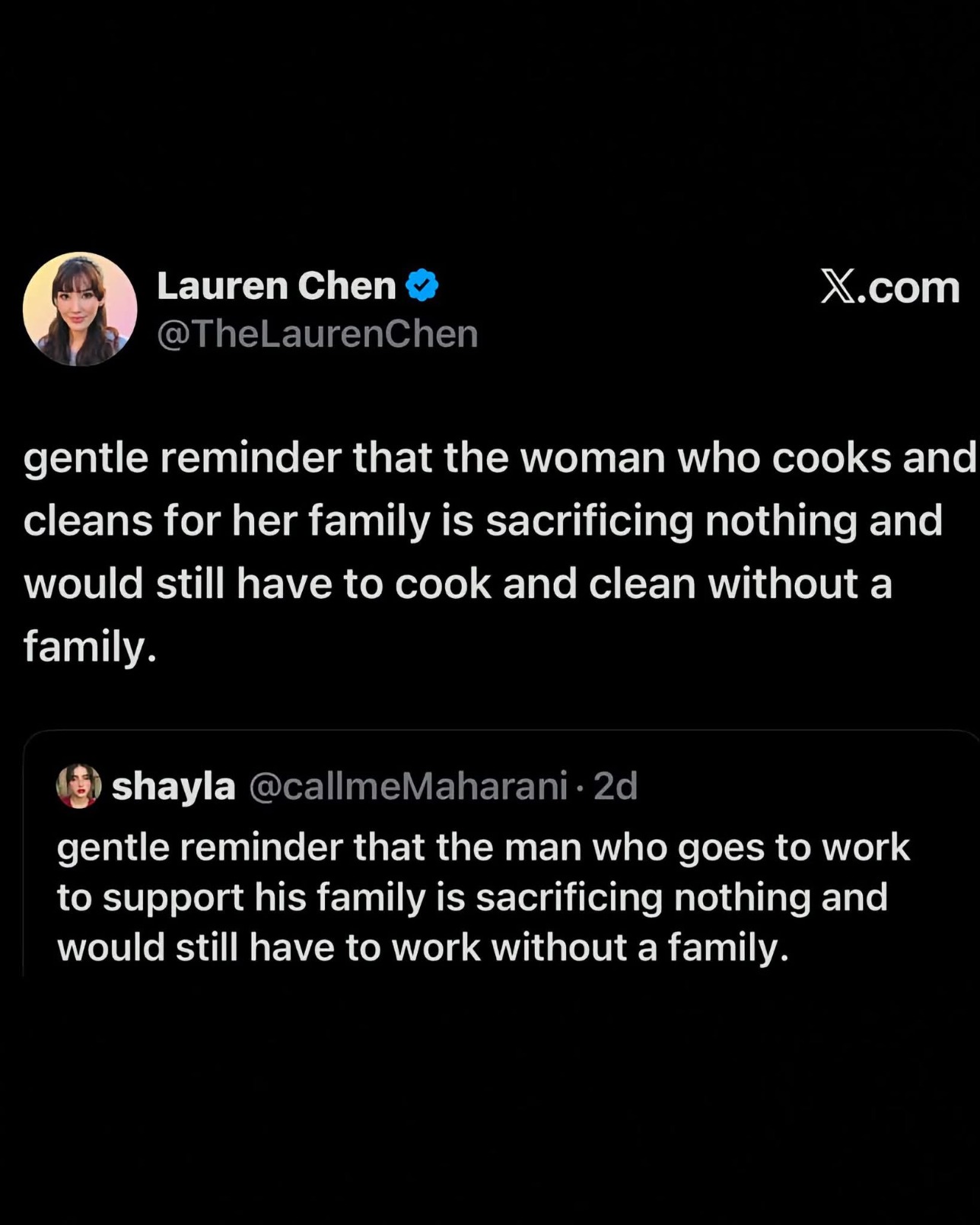
A man has to work considerably less hard and less rigourously to provide for only himself versus a whole family. This may be true for cooking and cleaning, but to far less of an extent.

The reactions from both sides of the aisle regarding Fauci tells us something very important. That is that hardly anyone has changed their opinion on him. Shills on the left still praise him while everyone on the right was already against him. No one who already knew of his bullshit has found out anything new, and those who praise him as a saint have no idea what people against him state as their reasons.
In the end, I see no evidence of "the people are waking up."

@Tfmonkey Anecdotal report on farming situation in my neck of the woods. Did a small road trip recently and in my area (where farming most certainly makes up most of the land use), and I did see almost every field having crops growing.
Not saying you are wrong about many farms not having planted crops, and maybe the effects you are describing will be delayed later. But at the very least, the fertilizer issues have not become much of a factor yet in my area.




Looks like this will be my new home. Warning: I (probably) have Asperger's, so my be prepared for my autism to show through.
I don't think I am a right wing extremist, but I am sure anyone with low testosterone might think otherwise.
Joined Sep 2022